Updated: 5 February 2025
Business Asset Disposal Relief (BADR) is one of the most effective ways to lower the tax you need to pay when closing a company. However, upcoming changes to BADR rates mean it’s more important than ever to act quickly to protect your profits.
This guide will show you exactly how BADR works, how to calculate your savings step-by-step and how to avoid costly mistakes. If you’re planning to close your company through a Members’ Voluntary Liquidation (MVL), understanding BADR can help you unlock substantial tax savings and keep more of your money.
Please note that Clarke Bell are not tax experts. We recommend consulting your accountant or tax advisor to discuss your specific tax circumstances.
What is Business Asset Disposal Relief?
Business Asset Disposal Relief (previously called Entrepreneurs’ Relief) is a Government-approved tax incentive designed to help business owners pay less Capital Gains Tax (CGT) when they sell or close their business. Instead of paying the standard CGT rates, qualifying business owners can benefit from a much lower tax rate on profits made from selling business assets.
There is a £1 million lifetime cap on the amount of gains that can qualify for this relief. This means you can claim BADR multiple times, but your total relief cannot exceed £1 million in gains.
Even with the upcoming tax rate increases announced in the Autumn Budget 2024, BADR continues to offer a significant tax advantage for business owners looking to exit their company in a tax-efficient way.
Who can claim Business Asset Disposal Relief?
To qualify for Business Asset Disposal Relief, you must meet certain eligibility criteria when closing or disposing of your business. BADR provides substantial tax savings for business owners who have worked hard to build their company and are now looking to exit in a tax-efficient way.
If you’re closing a business
If you’re a sole trader or part of a business partnership, you may qualify for BADR when closing your business. However, you must meet all of the following conditions:
- You are a sole trader or a business partner in the company.
- You have owned the business for at least two years before selling or closing it.
- If you’re closing the business, you must sell or dispose of business assets within three years of ceasing operations.
For directors of solvent companies, closing the business through a Members’ Voluntary Liquidation ensures that profits are distributed as capital, allowing you to benefit from BADR’s reduced tax rate of 10%.
Related: How Does Business Asset Disposal Relief Work In a Liquidation?
Other uses of BADR
In addition to closing a business, BADR may also apply when selling shares, securities, or business assets. For example, directors selling shares in their trading company or employees disposing of Enterprise Management Incentive (EMI) shares may qualify if specific conditions are met.
However, these scenarios involve complex eligibility rules, and it’s essential to consult your accountant for guidance.
How to calculate Business Asset Disposal Relief
Here’s a simple guide on working out how much you could save with BADR compared to standard Capital Gains Tax rates when closing a solvent company with an MVL.
While this guide provides a general overview of how Business Asset Disposal Relief can reduce your tax bill, Clarke Bell does not provide tax advice.
The following calculations are simplified examples to help you understand the potential savings. For detailed and accurate calculations tailored to your situation, we recommend consulting your accountant or referring to the GOV.UK website.
Step 1: Work out your total taxable gain
First, figure out how much profit you’re making from closing your business.
How to calculate it:
- Add up the total funds you’ll receive after closing the business.
- Subtract the amount you originally invested in the company.
Example:
- Your company has £100,000 in retained profits.
- You originally invested £10,000 in the company.
Total Gain:
- £100,000 – £10,000 = £90,000 taxable gain.
Step 2: Deduct allowable costs
You can reduce your taxable gain by subtracting any allowable costs related to closing your business. These may include:
- Insolvency Practitioner fees for handling the MVL.
- Accountancy fees for finalising the company’s accounts.
Example:
- Clarke Bell MVL fee: £995.
- Accountancy fees: £500.
Total Allowable Costs:
- £995 + £500 = £1,495.
Revised Gain:
- £90,000 – £1,495 = £88,505.
Step 3: Apply your tax-free allowance
Next, deduct your Capital Gains Tax-free allowance (known as the Annual Exempt Amount). For the 2024/25 tax year, this allowance is £3,000.
Example:
- Taxable gain after costs: £88,505.
- Annual Exempt Amount: £3,000.
Final Taxable Amount:
- £88,505 – £3,000 = £85,505
Step 4: Apply the BADR tax rate
Now, apply the correct tax rate to your taxable gain. With BADR, the current rate is 10% (if the MVL is completed before 6 April 2025). Without BADR, standard CGT rates apply:
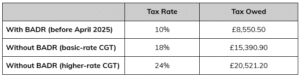
Potential Savings:
- £6,840.40 saved compared to the 18% rate.
- £11,970.70 saved compared to the 24% rate.
By claiming BADR, you could cut your tax bill by more than half, leaving you with significantly more of your company’s profits.
How to claim Business Asset Disposal Relief
There are two ways to claim Business Asset Disposal Relief (BADR). Here’s how to make your claim and ensure you maximise your relief. We strongly recommend consulting your accountant to ensure your claim is accurate and compliant with HMRC requirements.
1. Claim through your Self-Assessment Tax Return
The most common way to claim BADR is through your Self-Assessment Tax Return.
How to do it:
- Complete the Capital Gains Summary (SA108) section of your tax return.
- Clearly state that you are claiming Business Asset Disposal Relief.
- Provide details about the business disposal, including the amount of the gain and the qualifying business asset.
This option is ideal if you already file a Self-Assessment Tax Return for other income.
2. Use the Business Asset Disposal Relief helpsheet
If you need extra guidance, HMRC provides a Business Asset Disposal Relief helpsheet (HS275). This helpsheet walks you through the process of claiming the relief.
How to do it:
- Download the HS275 helpsheet from the HMRC website.
- Complete Section A, which asks for details about your business sale or asset disposal.
- Submit the helpsheet alongside your tax return or send it directly to HMRC.
This method is helpful if your tax situation is more complex and you need to explain specific details of your claim.
Important deadlines for claiming BADR
Timing is crucial. BADR must be claimed by the first anniversary of the 31 January following the end of the tax year in which you sold or closed your business.

Failing to claim by the deadline means you won’t be able to benefit from BADR, and your profits could be taxed at standard Capital Gains Tax rates.
Why an MVL is still the smartest choice for closing a solvent company
If you’re a director looking to close a solvent company with assets over about £25,000, a Members’ Voluntary Liquidation (MVL) is one of the most tax-efficient ways to do it.
An MVL allows company profits and assets to be distributed as capital rather than income. This means you can take advantage of the reduced Business Asset Disposal Relief, significantly lowering your Capital Gains Tax liability.
Without an MVL, funds withdrawn from the company could be taxed as dividends or income, which are often taxed at much higher rates:
- Up to 39.35% on dividend income for higher-rate taxpayers.
- 40% or 45% on income taken as salary or bonuses.
In contrast, an MVL lets you pay just 10% CGT on qualifying gains under BADR, offering substantial tax savings.
With the upcoming tax changes from the Autumn Budget 2024, timing is critical. The current 10% BADR rate will increase to 14% from 6 April 2025 and then to 18% from April 2026.
Related: Members’ Voluntary Liquidation Tax: A Guide for Directors
How Clarke Bell can help
Clarke Bell offers a fixed-fee MVL service starting from £995 + VAT + disbursements, providing a fast and cost-effective way to close your solvent company. We handle the entire process efficiently, ensuring you maximise tax savings by benefiting from BADR.
Contact us now for a free, no-obligation consultation and let us help you close your company in the most tax-efficient way possible.